What Is CGM SKD? A Complete Guide to Semi-Knocked-Down CGM Manufacturing
Share
If you sell or distribute continuous glucose monitoring (CGM) systems, you have probably weighed two options: import a finished device under someone else's brand, or build your own CGM from scratch. Both have obvious costs — heavy import duties and thin margins on one side, years of R&D and capital on the other.
CGM SKD is the middle path. It lets you put your own-brand CGM on the market in your own country, with the highly engineered part already done at the factory and the final, locally relevant part — assembly, packaging, branding and regulatory paperwork — done by your team.
This guide explains what a CGM SKD kit actually contains, how the model works step by step, where the cost and compliance advantages come from, and what to check before signing with a supplier.
Verid Bio was the first CGM provider to enable SKD/CKD production models overseas. This guide is written from that operating experience — not from theory.
What does CGM SKD mean?
CGM SKD stands for Continuous Glucose Monitor Semi-Knocked-Down. The device leaves the original manufacturer's factory partly assembled rather than fully finished. The manufacturer builds and tests the technically demanding components — sensor electrode fabrication, membrane coating, calibration, needle loading — and ships them as a kit. Your business then completes the final steps locally: assembly, packaging, labelling and local regulatory registration.
The result is a finished product that can qualify as locally manufactured, which is what opens the door to government tenders, local-content programmes, and reduced import duties — while still carrying your own brand.
SKD vs. CKD vs. OEM: where the line is
| Model | What you receive | Who finishes the device | Typical use |
|---|---|---|---|
| OEM / finished goods | A complete, certified device | Manufacturer | Fast entry, highest landed cost |
| SKD (semi-knocked-down) | Core components, tested and calibrated | You, with training and SOPs | Local production + local registration |
| CKD (completely knocked-down) | Nearly all parts, largely unassembled | You, with deeper capability | Full manufacturing footprint |
SKD sits in the middle on purpose: enough is done at the factory to keep local assembly simple and repeatable, and enough is left to your business to control branding and satisfy local rules.
What is inside a CGM SKD kit?
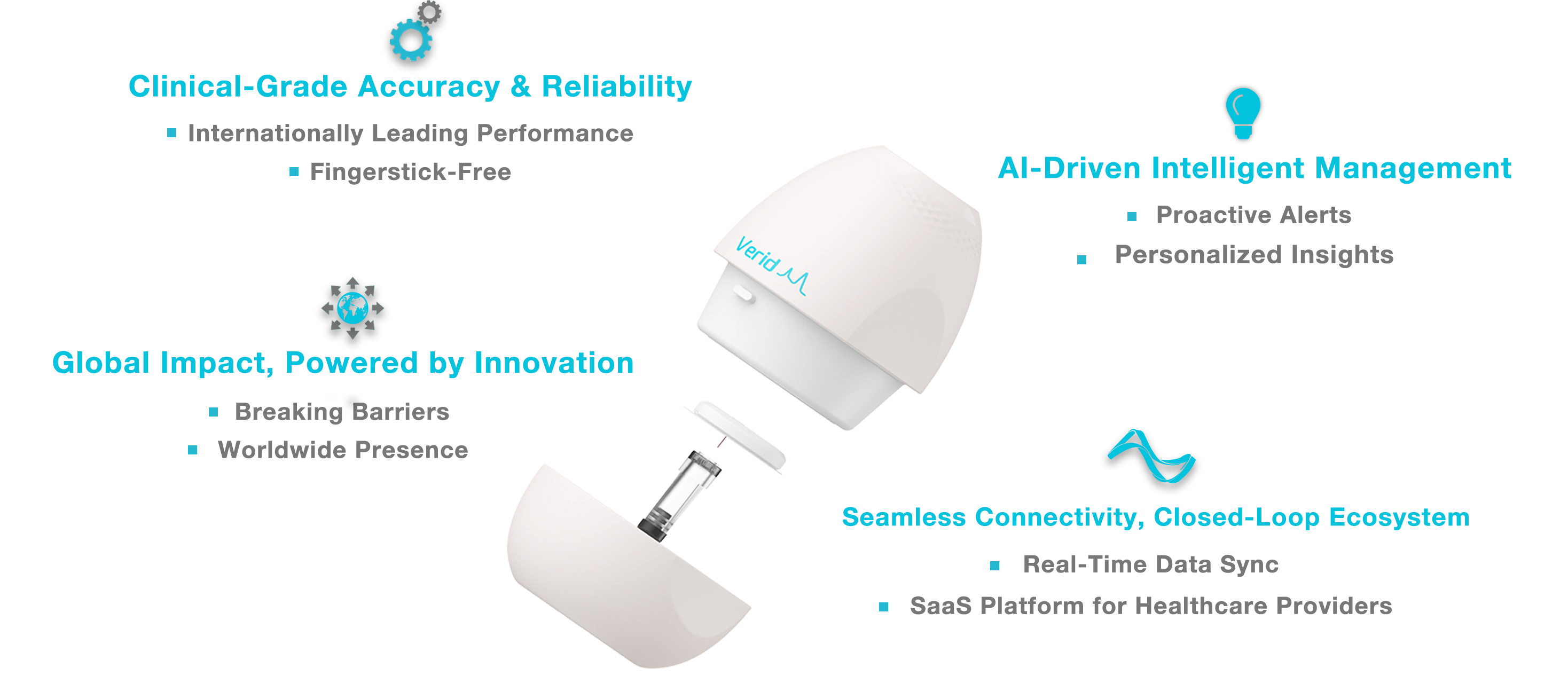
A CGM SKD kit typically ships as a small set of major components rather than hundreds of loose parts. In a Verid Bio kit, that means:
- Sterilized sensor kit — the sensing element, produced and tested at the factory
- PCBA transmitter — the electronics that convert the sensor signal into a radio transmission
- Battery — the power source for the wear period
- Applicator main body — the mechanism that inserts the sensor
- Applicator bottom cover — the mating part that completes the applicator
The engineering work that makes a CGM accurate — electrode chemistry, membrane control, calibration and final QC — stays with the manufacturer (see the CGM platform it powers). The work that makes a CGM yours — assembly, labelling, language, packaging, registration — moves to your facility. Connecting the parts is usually a snap-fit operation with an audible confirmation, so a trained team can reach a stable assembly routine quickly.
How the CGM SKD model works: step by step
SKD is a partnership, not a purchase order. A typical sequence looks like this.
Step 1 — Requirement alignment. You share your company profile, target market and available resources. The manufacturer assesses whether SKD is a realistic fit, and what kit configuration your market needs.
Step 2 — NDA and in-depth assessment. With an NDA in place, you evaluate a sample kit and both sides assess the local regulatory route: what your authority will require, and what documentation the manufacturer must supply.
Step 3 — Formal agreement. Kit configuration, pricing, minimum order quantity, branding scope, assembly standards and support boundaries are defined in writing. This is also when territory structure is agreed.
Step 4 — First shipment and capability enablement. You receive the first kits together with training material, assembly SOPs and the regulatory documentation package for your registration.
Step 5 — Local certification and ongoing supply. Your business leads the local approval process using the technical file provided. The manufacturer continues supplying components as your volume grows.
Where the advantages come from
Tariff and landed-cost structure
Finished medical devices often attract higher duties than components, and several markets give preferential treatment to goods with meaningful local value-add. Assembling locally can move your product into a different duty and procurement category — which is a structural margin difference, not a one-off discount.
Local registration and tenders
Many national health programmes and public tenders favour — or explicitly require — locally manufactured product. Local final assembly plus local registration is often the difference between being eligible to bid and not being eligible at all.
Brand and lifecycle control
Because packaging and documentation arrive unbranded, you control the box, the manual, the language and the app experience. Your patients see your brand, and the customer relationship stays with you.
Faster path to a real product line
Building a CGM from scratch is a multi-year, capital-intensive programme. SKD removes the sensor development phase from your critical path and puts you in market in a fraction of that time, while you build manufacturing experience in parallel.
Manufacturing models change CE strategy
One point worth understanding early: with SKD, the finished product does not exist until you assemble it. That changes who holds which certification. The manufacturer's job is to supply the technical and clinical documentation — performance verification reports, quality management certification (for example ISO 13485), design and manufacturing information — that your local registration needs. Your job is the local approval.
In the European Union, CGM devices generally fall under Class IIb under the Medical Device Regulation and involve a Notified Body; requirements differ by market, so confirm the exact route with your local authority before planning a launch date. Partners planning a deeper production footprint usually step up through our Leadership Alliance programme.
Who the CGM SKD model fits
SKD works best for organisations that already have a route to patients:
- Pharmacy chains and retail health networks — keep the CGM margin inside your own business instead of passing it upstream
- Distributors and importers — move from reselling someone else's brand to owning your own line, with a defensible territory
- Telehealth and digital health platforms — pair your own hardware with the software stack you already operate
- Health systems and procurement groups — secure steadier supply and pricing than routing every order through a reseller
- Government programme operators — meet local-content goals while keeping unit economics workable
If you fit more than one profile, SKD can usually support both goals at once, because the underlying process is the same.
What your facility needs before you start
Most partners begin with three things:
- Environmental: a cleanroom rated Class 10,000 (ISO 8) or higher for sensor housing assembly
- Equipment and quality: an ISO 13485 quality management system, or an equivalent system
- Staffing: basic cleanroom protocol knowledge is enough to start — full assembly training is provided by the manufacturer
Eight questions to ask a CGM SKD supplier
Before signing, put these on the table:
- What exactly is included in the kit, and what is not?
- Which certifications and quality-system documents do you hold?
- Which technical documents will you supply for my local registration?
- What assembly training and SOPs are included, and how is refresher training handled?
- What is the outgoing quality and batch-testing regime, and what are the acceptance criteria?
- How is component supply continuity protected as my volume grows?
- Do you limit the number of SKD partners in a single country?
- Can we start with a pilot order before committing to annual volume?
A supplier who answers these in writing, with documents, is a different kind of partner from one who answers them in a sales deck.
Beyond manufacturing: what else should come with the kit
Components alone do not make a product line. A complete SKD partnership also brings:
- Regulatory documentation support — the technical file your registration depends on
- Software access — a patient or clinician application available via API or SDK, so your hardware has a data experience behind it
- Branding scope — packaging, manual and app localisation in your market's language
- Territory structure — clear exclusivity terms, usually one partner per country
That software layer matters more every year: the value of a CGM is increasingly the data it produces, not only the sensor that produces it — which is why accuracy metrics such as MARD matter commercially, not just clinically.
Frequently asked questions
Is CGM SKD the same as OEM? No. OEM supplies a finished, certified device for you to brand and resell. In SKD, the device is not finished when it reaches you — you complete assembly locally, which is what enables local content, local registration and different duty treatment.
How difficult is local assembly? Component connections are designed as guided snap-fit operations, with assembly SOPs and training provided. Teams without prior CGM experience typically establish a repeatable assembly routine during enablement, then improve cycle time with volume.
Do I need a cleanroom? Final sensor housing assembly requires a controlled environment — typically Class 10,000 (ISO 8) or higher. If you already serve clinics or pharmacy networks, this is usually the largest capability you need to add.
Can I start small? Pilot orders are normally available to validate both the product and your assembly process before committing to annual volume. Treat the pilot as the entry point to a long-term agreement rather than a substitute for one.
Do I need my own CE marking or local approval? Yes — that is the point of local production. The manufacturer supplies the documentation; your organisation holds the registration in your market.
Next step
If you are evaluating a CGM SKD partnership, the fastest way to a real answer is a sample kit and a conversation about your market's rules.
Talk to our team about the CGM SKD model → — request a sample kit, discuss your territory, and see the components firsthand.