The Global CGM Dream Is Over. The Regional Era Has Begun.
Over the past few years, the global Continuous Glucose Monitoring (CGM) market has entered what many call a “gold rush” phase.
New players are emerging. Capital is flowing in. Manufacturing capacity is expanding rapidly. At the same time, demand for glucose monitoring continues to rise worldwide, driven by diabetes prevalence, aging populations, and increasing metabolic awareness.
On the surface, it looks like a classic globalization story.
But structurally, the CGM market is moving in the opposite direction.
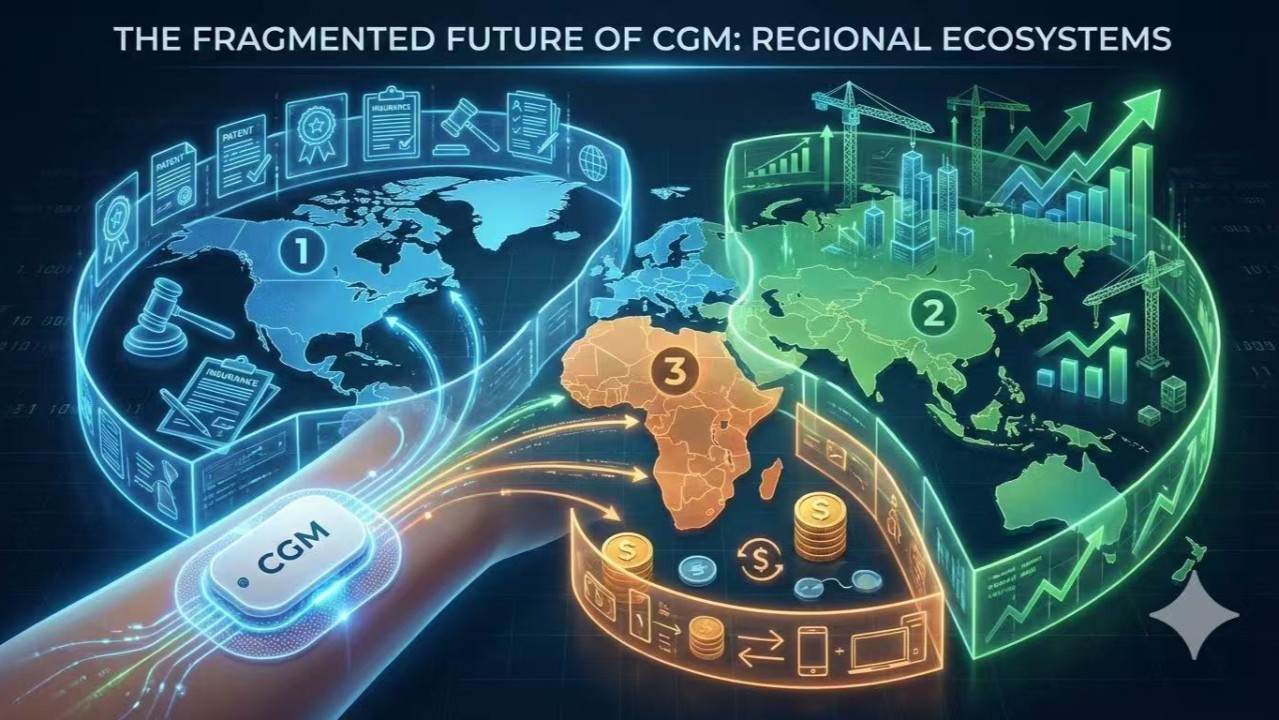
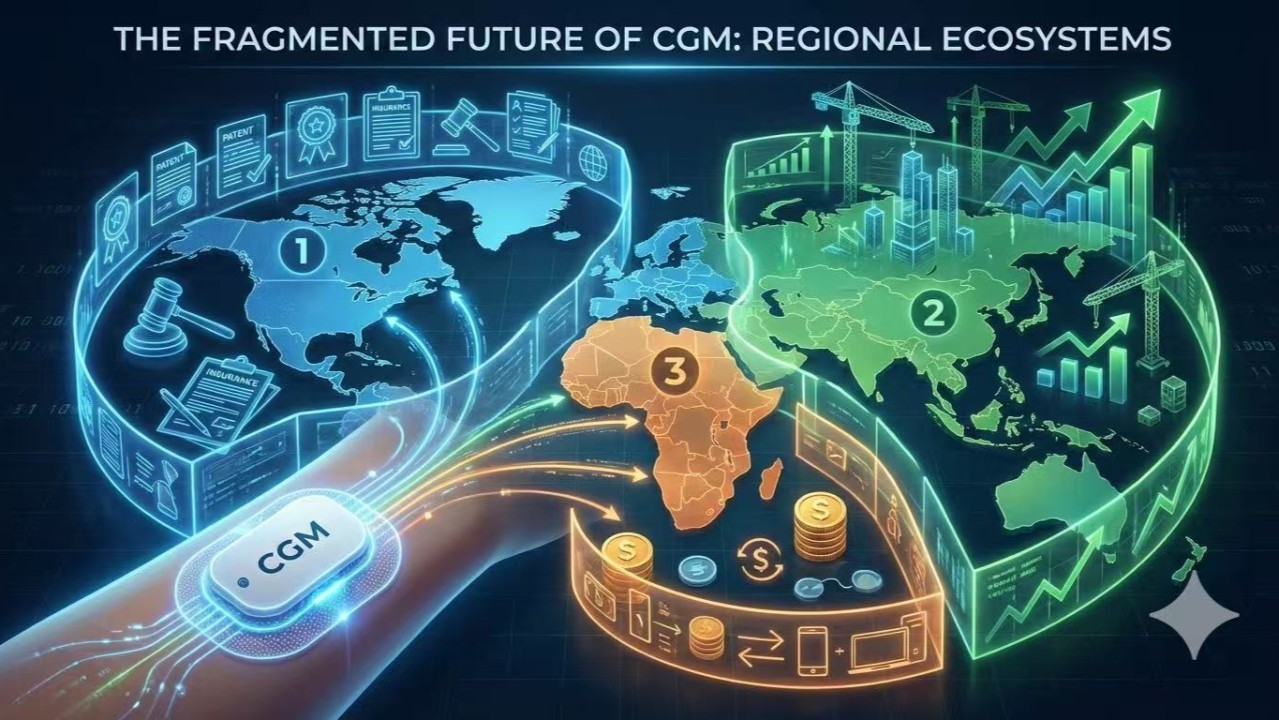
Instead of becoming a single global battlefield, CGM is evolving into multiple regional ecosystems — each shaped by patents, reimbursement systems, regulatory dynamics, and healthcare economics.
And this shift may define the next decade of competition.
If Demand Is Global, Why Isn’t Competition?
CGM demand exists everywhere. Competitive access does not.
In the US and core European markets, competition remains concentrated around a few dominant players such as Dexcom and Abbott Laboratories.
These markets are defined by:
- Deep patent portfolios
- Long-term clinical data
- Strong payer integration
- Established reimbursement coding
Entering is not only a technical challenge — it is a structural one.
Three Forces Quietly Dividing the Market
The CGM industry is not fragmenting by accident. It is being shaped — quietly but structurally — by three long-term forces.
1-Patent Architecture
In mature markets, CGM is not just a product — it is a layered intellectual property system.
Core elements are often surrounded by multiple patent layers. Even when one patent expires, adjacent protections frequently remain active. This does not make entry impossible — but it makes it legally and financially calculated.
As a result, companies do not compete everywhere. They compete where their exposure is manageable.
2-Reimbursement Economics
CGM adoption is deeply linked to who pays.
In the US, coverage decisions are driven by insurance coding and payer negotiation. In Europe, centralized health systems influence pricing and access. In many emerging markets, out-of-pocket payment still plays a dominant role.
The same product can sit in completely different economic environments depending on geography.
And pricing logic defines strategy.
A reimbursement-driven market rewards clinical depth and long-term data. A self-pay market rewards affordability and accessibility.
3-Regulatory Tempo
Approval timelines and regulatory philosophies vary significantly.
FDA pathways demand specific evidence structures. CE mark follows different evaluation logic. Middle Eastern and Asian markets have their own review pace and local requirements.
Regulatory sequencing often determines market prioritization.
When approval speed, compliance cost, and documentation standards differ, companies naturally allocate resources regionally rather than globally.
A Three-Tier Ecosystem Is Emerging
When these forces interact — patents, reimbursement, regulation — the result is not a unified global market.
It is stratification.
Rather than one competitive arena, we are seeing layered ecosystems form.
Tier 1: High-Barrier Mature Markets
Primarily the US and core EU countries.
These markets are defined by:
- Insurance-backed demand
- High average selling prices
- Strong clinical evidence requirements
- Established brand dominance
Competition here is less about entering — and more about sustaining.
Success depends on integration into broader diabetes management systems, payer relationships, and long-term clinical credibility.
It is a moat-based ecosystem.
Tier 2: High-Growth Emerging Healthcare Markets
Regions such as Saudi Arabia, Southeast Asia, and parts of Latin America.
These markets are expanding quickly, but are less locked into legacy CGM structures.
Reimbursement is developing. Government procurement is increasing. Private sector demand is growing.
This creates space for multiple players — particularly those with competitive pricing and flexible distribution models.
The ecosystem here is still forming.
Tier 3: Price-Driven Access Markets
In lower-income regions, CGM remains in early adoption stages.
Reimbursement is limited. Healthcare infrastructure may be uneven. Patient education costs are high.
Here, affordability is often the primary gatekeeper.
The competitive dynamic begins to resemble consumer electronics:
- Cost efficiency
- Channel reach
- Operational scalability
Rather than brand legacy or patent strength.
What may be happening is deeper than market segmentation.
CGM is no longer competing as a uniform medical device category. It is being redefined by each region’s healthcare economics.
In mature systems, it behaves like a highly regulated therapeutic infrastructure. In growth markets, it functions as an expanding chronic care solution. In access-driven regions, it approaches affordable health technology.
The same sensor. Different systemic roles.
And when roles differ, strategies must differ.
Closing Thought
The CGM market is global in demand — but regional in structure.
Understanding that distinction may be the difference between aggressive expansion and sustainable positioning.
As the industry matures, strategy may depend less on ambition and more on ecosystem fit.
And perhaps the winners of the next decade will not be those who try to enter every market — but those who deeply understand the one they are built for.