CGM Warm-Up Time: A Timer or a Stabilization Problem?
Most people think CGM warm-up time is just a waiting period.
30 minutes.
1 hour.
2 hours.
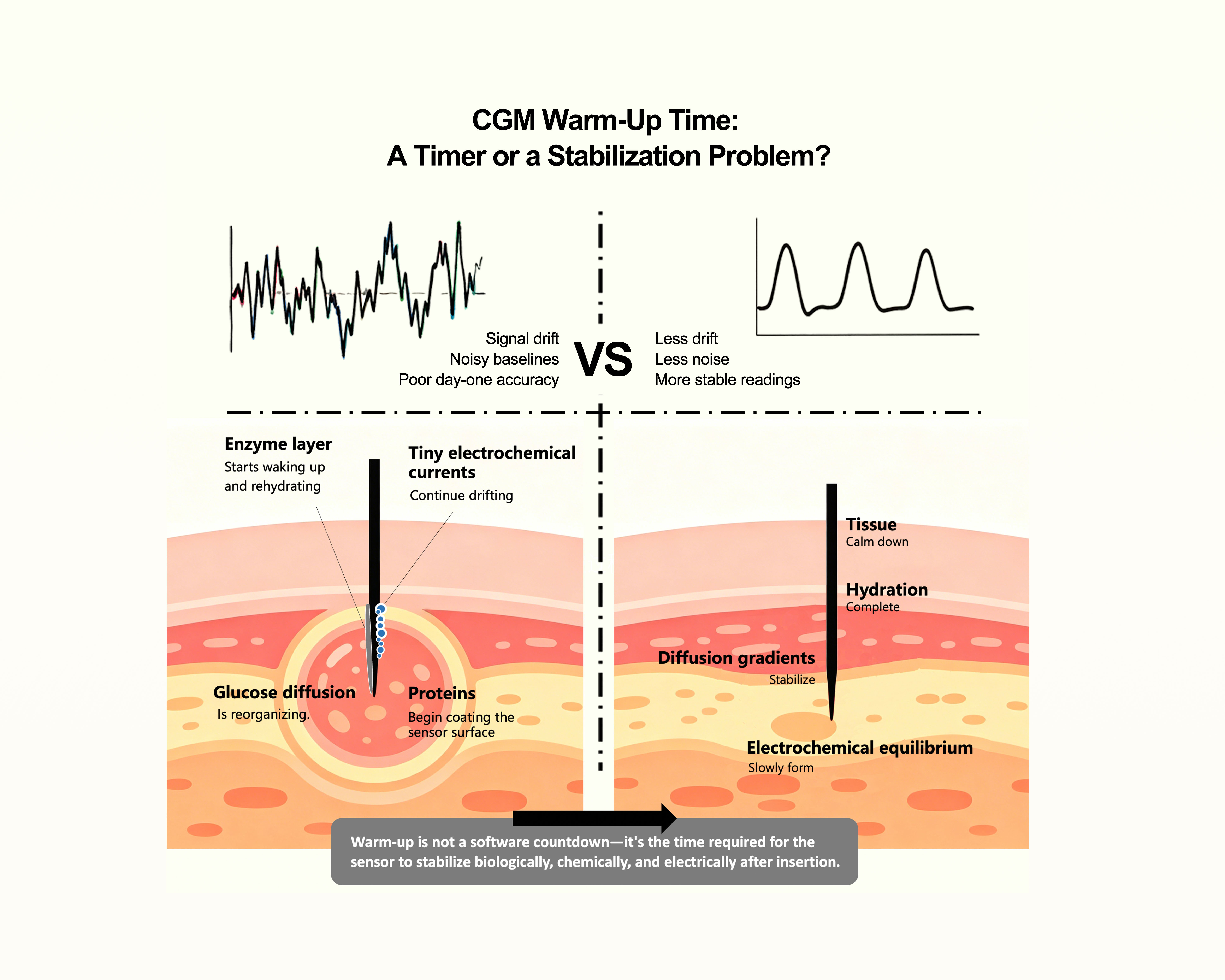
But warm-up is not simply a software countdown.
It is the time required for a newly inserted sensor to stabilize inside the body-biologically, chemically, and electrically.
And ironically, one of the easiest ways to improve early sensor performance is simply to wait longer before activating it.
Less drift.
Less noise.
More stable readings.
Which raises an interesting question: If waiting solves so many problems naturally —why is shortening warm-up time considered such a major technological achievement?
The moment a CGM sensor enters the body, almost nothing around it is stable.
The tissue has just been injured.
Proteins immediately begin coating the sensor surface, a process known as bio-fouling, like biological dust.
The enzyme layer starts waking up from a dry storage state and slowly rehydrating.
Glucose diffusion around the membrane is still reorganizing.
Tiny electrochemical currents continue drifting before reaching equilibrium.
In other words: the sensor may already be generating signals within minutes, but the in-vivo environment itself is still unstable. And this is what makes modern CGM so difficult.
The challenge is not measuring glucose.
The challenge is making a freshly injured biological environment behave like a stable real-time laboratory system within less than an hour.
That is an extraordinarily hard engineering problem.
Because every shortcut has consequences.
Reduce warm-up too aggressively, and instability leaks into the readings:
Signal drift
Noisy baselines
Poor day-one accuracy
Historically, the industry solved this problem with patience-Just wait longer.
Allow the tissue to calm down.
Allow hydration to complete.
Allow diffusion gradients to stabilize.
Allow electrochemical equilibrium to slowly form.
It is one reason why many experienced CGM users quietly believe Day 2 is often better than Day 1.
But modern CGM systems are trying to solve the problem differently.
Instead of waiting for stabilization to happen naturally, they are increasingly engineered to force stabilization to happen faster.
Smaller insertion trauma.
More hydrophilic membranes.
Preconditioned electrochemical interfaces.
Faster enzyme hydration.
Smarter compensation algorithms.
In many ways, warm-up time has become one of the clearest windows into a manufacturer’s true systems engineering capability. Because wear duration and warm-up time are actually mirror images of the same problem:
One asks: “How long until the system becomes stable?”
The other asks: “How long can the system remain stable?”
And personally, I still remain somewhat cautious about some of the emerging “15-minute warm-up” claims in the industry (same as 21-day wear time in my last article).
Not because chemistry and algorithms cannot improve. They absolutely can.
But some processes inside the body still require time, mass transport, and physical stabilization.
And physics is usually much less negotiable than marketing timelines.