The Sterility Paradox: Why CGM Sensors "Drift" in the Chamber
-Is Sterilization the “Silent Killer” of CGM Accuracy?
In the CGM world, most engineering debates focus on enzyme chemistry, signal processing, or algorithms.
But what if the real battle for accuracy happens somewhere far less glamorous?
Inside the sterilization chamber.
The Sterility Paradox
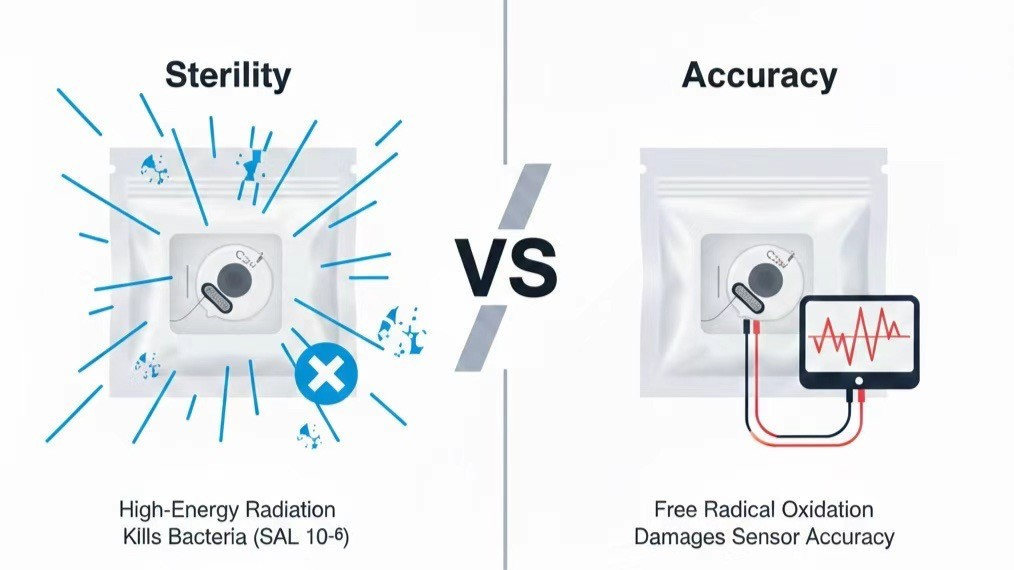
To meet the mandatory Sterility Assurance Level (SAL) of 10⁻⁶, CGM sensors must endure high-energy radiation.
Here’s the paradox:
Sterility and accuracy are not independent variables. They are competing outcomes of the same reaction.
A Regulatory Wake-Up Call
In early 2026, the FDA issued a warning letter to a major CGM manufacturer. One key issue: finished devices were not adequately evaluated after sterilization.
Component testing before the chamber cannot predict what happens inside it.
Radiation does not just sterilize. It alters membranes, enzymes, and long-term performance.
This is where “functional drift” begins.
1-The Physics: Oxygen Makes the Difference
Why do some sensors tolerate Electron Beam (E-beam) but struggle under Gamma irradiation?
The answer lies in the Dose Rate Effect .
Gamma: The Slow Exposure
Gamma irradiation delivers energy over hours. During that time, oxygen diffuses continuously into the polymer membrane.
Radiation converts oxygen into peroxyl radicals →
Peroxyl radicals drive chain scission →
Polymer chains break.
Result: The membrane becomes brittle and more porous. Glucose diffusion accelerates. Under hyperglycemia, the signal can saturate — the dreaded “flatline.”
E-Beam: The Instant Pulse
E-beam delivers the same total dose in seconds.
Oxygen inside the material is consumed rapidly, creating a transient anaerobic state.
Without oxygen driving degradation, polymer radicals recombine → cross-linking .
Result: The membrane structure tightens. Selectivity may even improve. Signal stability is preserved.
Same dose. Different physics. Different outcome.
2-The Biology: Enzyme Survival Is Not Guaranteed
At the center of every CGM sensor is Glucose Oxidase (GOx) — a fragile protein.
Radiation splits water molecules inside the hydrogel:
H₂O → ·OH (hydroxyl radicals)
These radicals trigger what can only be described as a free radical storm .
They can:
- Oxidize amino acid residues
- Disrupt protein folding
- Eject the FAD cofactor from the active site
Once FAD leaves, the enzyme is biologically inert.
Typical sterilization cycles can reduce catalytic activity by 30–50% .
Manufacturers compensate by loading excess enzyme into the sensor — a built-in redundancy tax.
3-The Hidden Risk: Functional Drift
Sterilization doesn’t just reduce signal strength.
It can change membrane permeability to interferents such as acetaminophen.
This means:
A sensor that looks accurate before sterilization may behave differently after final packaging.
This is no longer just an engineering concern.
It is increasingly a regulatory focus .
Finished device performance — not component testing — is becoming the audit standard.
The Bigger Question
As CGM scales to tens of millions of units annually:
Are we engineering sterilization as carefully as we engineer chemistry?
Because in a medical device, accuracy is not defined at the prototype stage.
It is defined after the chamber door opens.
Disclosure: The data and evaluation framework discussed in this article are based on internal engineering testing conducted by the CGM R&D team at Verid Bio . This post is shared from a technical perspective to support professional discussion within the CGM and digital health community.