CGM is not getting easier -the barrier is just moving
One thing has become hard to miss over the past one or two years: more and more companies are entering the CGM space.
After speaking with several suppliers in the industry recently, one change stood out clearly:
More and more parts of CGM development can now be outsourced or directly purchased from the market.
A few years ago, building a CGM still meant doing too many things yourself. You had to figure out the sensor, the chemistry, the process, the testing, the assembly, and the system logic — and then somehow make all of them work together.
Now the picture looks very different: Suppliers can offer automation lines. They can offer electrode process solutions. They can offer enzyme and membrane systems. They can offer electrochemical testing platforms. Some can even offer parts of the algorithm, or something close to a complete product package.
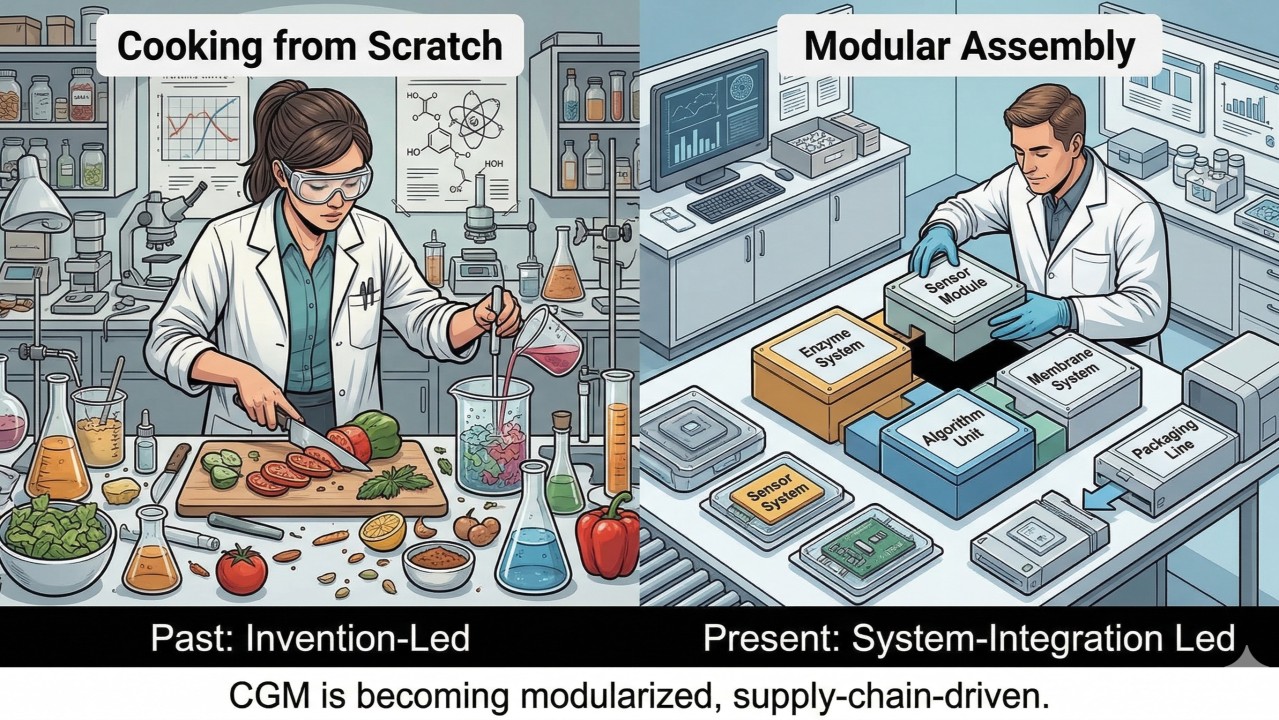
Building a CGM today feels less like cooking from scratch, and more like working with prepared ingredients — sometimes even a prepared dish.
You no longer need to grow the vegetables, buy the meat, clean and cut everything, and figure out the recipe from zero. Much more is already prepared for you.
But that does not mean anyone can suddenly become a great chef.
That is the key point.
CGM is not becoming simple. It is becoming modularized, supply-chain-driven, and increasingly platformized.
The difficulty has not disappeared. It has shifted.
For a long time, the main barrier in CGM was whether a company could build the core technology at all. That was the stage when the industry was still technology-led. The hardest questions were basic but brutal: Can the chemistry hold? Can the signal stay stable? Can the sensor last? Can the system deliver clinically acceptable performance?
At that stage, there is not enough standardization yet, and too much uncertainty. The industry was still trying to prove what works.
But once a product category matures, something important happens.
The winning technical path becomes clearer. The know-how starts to spread. What used to stay inside one company begins to flow outward — into equipment makers, material suppliers, process vendors, testing platforms, and contract manufacturers.
That is when an industry starts to change character.
It is no longer only about invention. It is increasingly about system integration.
Once a product reaches a certain level of technical maturity, scale, and repeatability, it begins to follow the logic of industrialization. At that point, its trajectory starts to look surprisingly similar to other industrial products — smartphones, EVs — where competition shifts from invention to integration.
As that happens, the real moat in CGM may gradually move away from individual modules and toward the ability to turn those modules into faster learning cycles, repeatable performance, regulatory credibility, and market trust.
Now, with enough budget and the right partners, more companies can now assemble something that looks technically credible — on paper, or even in early testing.
The prototype barrier is falling fast. The industrialization barrier is not.
A prototype proves that something can work once. A product proves that it can work repeatedly — across batches, across users, across wear days, and across messy real-world conditions.
That is a completely different test.
Because in CGM, the real pain usually starts after the demo works.
Can performance stay consistent from batch to batch? Can sensor variation be controlled tightly enough? Can Day 10 or Day 14 still look acceptable, not just Day 1? Can the system hold up under sweat, motion, pressure, adhesion issues, signal drift, and user behavior that never appears in a clean lab setup? Can all of this be manufactured with real yield, real cost discipline, and real quality consistency?
This is where many “complete solutions” begin to show their limits.
This is not unique to CGM. It is what often happens when a supply chain becomes strong enough to package complexity into modules. Entry becomes easier. The market gets crowded. Products start to look more similar. For a period of time, everything feels possible.
China has seen this movie before in more than one industry.
When supply chains mature, the market usually goes through a phase of acceleration, enthusiasm, and sometimes noise. A lot of companies enter. A lot of products appear. A lot of people mistake fast assembly for lasting capability.
Then reality starts sorting things out.
And usually, only a small number of long-term players remain.
Not necessarily the ones who entered first. Not necessarily the ones who assembled fastest. But the ones who built something harder to copy.
Sometimes that advantage comes from technology. Sometimes from manufacturing discipline. Sometimes from channel strength, reimbursement access, clinical trust, regulatory execution, or business model design.
But in almost every case, the winners are the ones who turn modular pieces into something durable.
That may be where CGM is heading now.
So perhaps the question for the industry is no longer simply: Who can make a CGM?
A more useful question may be: Who can turn an increasingly modular set of building blocks into a product that is stable, scalable, trusted, and still differentiated after the excitement of easy assembly fades?