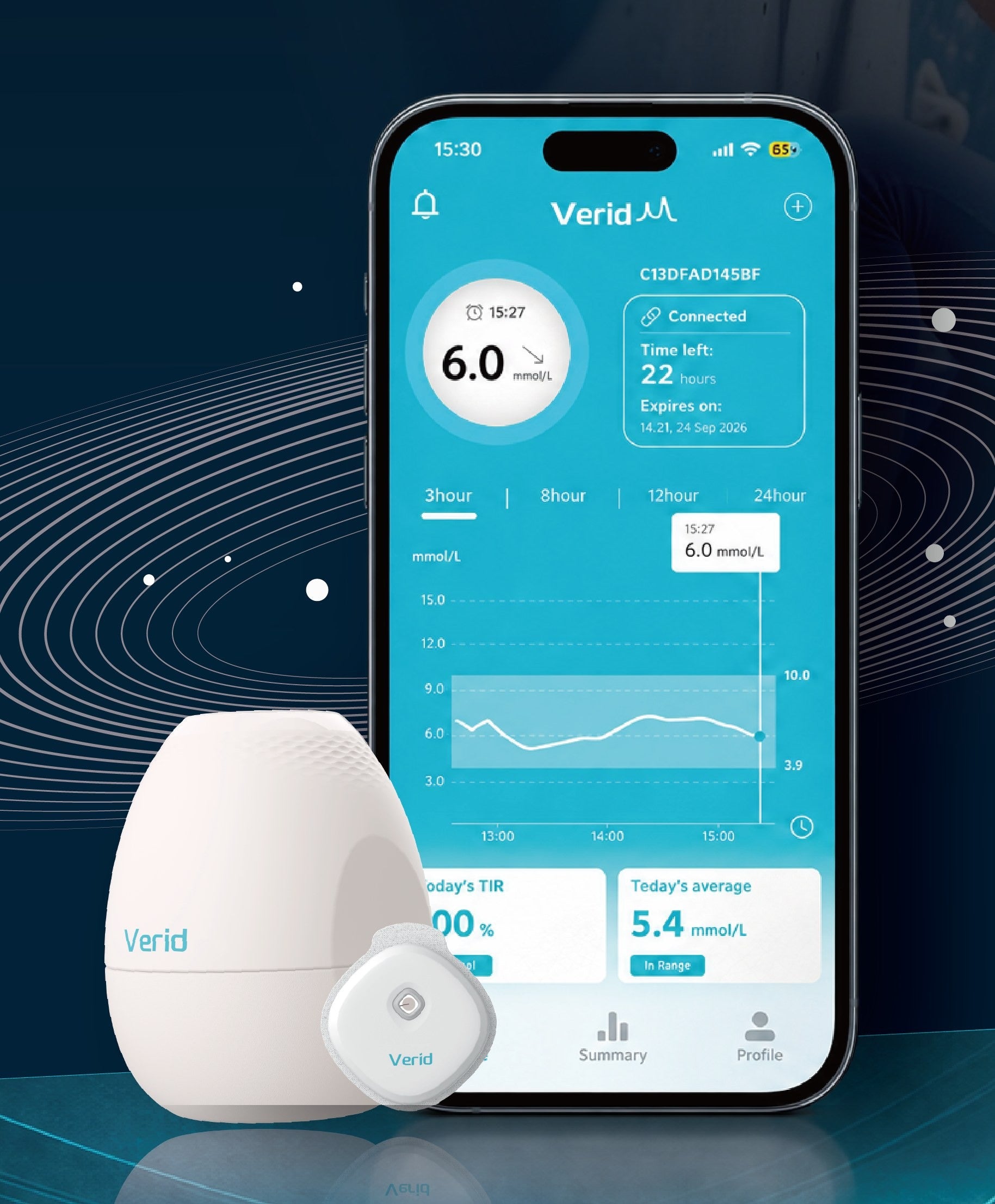
A certified CGM, under your brand.
You bring the brand, the market and the channel. We supply a complete, certified continuous glucose monitoring system — sensor, transmitter, applicator and app — in your packaging, under your name, without a factory of your own.
Our device. Your product.
In an OEM arrangement the device leaves our line finished and certified, and reaches your market carrying your brand. You are not assembling anything — you are launching a product line.
This is the right model when speed matters more than duty structure, or when local manufacturing capability does not yet exist in your organisation. It is also the usual first step before SKD: prove the market with a finished device, then decide whether the facility investment pays back.
Because the device is finished before it reaches you, your market treats it as an imported medical device. That has consequences for duty and for tender eligibility — both are set out in the comparison below, without spin.
What you receive
- Finished, certified sensor and transmitter system
- Your brand on packaging, label and instructions for use
- Companion app build under your brand, including TIR reporting
- Documentation set for your import and market access
- Launch assets: clinical data summaries, training material
How far the white label actually goes.
Private label arrangements vary widely between suppliers. This is the scope we work to — stated plainly so you can compare it against any other quote you are holding.
Device & packaging
Your brand, colours and artwork on the retail box, the sensor pouch and the applicator label.
Instructions for use
Manual and labelling in your market's language, laid out under your brand and reviewed with you.
Companion app
App icon, name and in-app identity under your brand. The certified platform underneath stays ours, which is what keeps it maintained.
Registration
Held by Verid Bio under a brand licence, with documentation support for your market access.
Sensor chemistry
Electrode fabrication, membrane and calibration are not transferable under OEM — that is what SKD and the Leadership Alliance are for.
Data platform
API / SDK access is available so your brand app can sit on top of the platform if you prefer to build your own.
The honest trade-off.
Both models put your brand on a CGM. The difference is whether your market sees an imported device or a locally manufactured one — and whether the registration sits with us or with you.
| If this is true | Choose |
|---|---|
| You need product in market this year | OEM |
| Public tenders require local manufacture | SKD |
| You have no facility and no regulatory team | OEM |
| Duty on finished devices is eating your margin | SKD |
| You want to keep your registration file in-house long term | SKD |
OEM works best for
- Brand owners extending an existing portfolio into glucose monitoring
- Telehealth and digital health platforms adding hardware to a software business
- Retail and pharmacy groups wanting an own-label CGM without a plant
- Distributors testing whether a market justifies local manufacturing later
Read the comparison
Our published guide covers OEM, private label, SKD and CKD side by side, including where each one breaks down.
CGM manufacturing models compared →From first call to first pallet.
01 · Alignment
Market, forecast, brand assets and the regulatory route for your country.
02 · Sample & spec
Evaluation units and the full specification, including app scope.
03 · Branding & agreement
Artwork, language, app build, minimum order and territory terms.
04 · Production & launch
Batch production, documentation handover and launch enablement.
OEM questions, answered.
Does OEM mean we own the design?
No. OEM means you own the brand and the market relationship; the design, the sensor chemistry and the certified platform stay with Verid Bio. If your goal is to hold the design and the registration, SKD is the closer fit.
Who is the legal manufacturer on the label?
Verid Bio, with your brand applied under a licence. That is the trade-off for the shorter timeline and the absence of local manufacturing obligations. Under SKD, your organisation becomes the legal manufacturer.
Can we have our own app instead of yours?
Yes, through API / SDK access with integration guidance. We confirm which data fields are exposed under your agreement before any development work starts, so you can plan against a fixed interface.
What is the minimum order?
Minimum order depends on the kit configuration, the branding scope and the app build — it is set in the agreement rather than published as a single number. Evaluation units are available before you commit.
Can an OEM partnership convert to SKD later?
Yes, and that is a common path. The platform is identical, so adding local assembly and filing in your own name is a commercial amendment plus an enablement programme — not a new product development cycle.